Fourteen checks,
in three places.
However you charge (fixed prices, hourly rates, visits, subscriptions, a price list, a till, bookings, fees on results or funded work), the questions are the same. Was it charged? At the right price? Was it collected? And did you pay only what you agreed?
Get paid for what you deliver.
The biggest and most common gaps: work that never became an invoice, or was invoiced for less than agreed.
- Delivered, not chargedWork, stages, visits, goods or placements that never reached an invoice or claim.For example: a completed stage on a fit-out job with no invoice, or a month of care hours never claimed.
- Charged below the agreed priceOld rates, out-of-date price lists or customer prices.For example: a senior consultant billed at £110 an hour against an agreed £125.
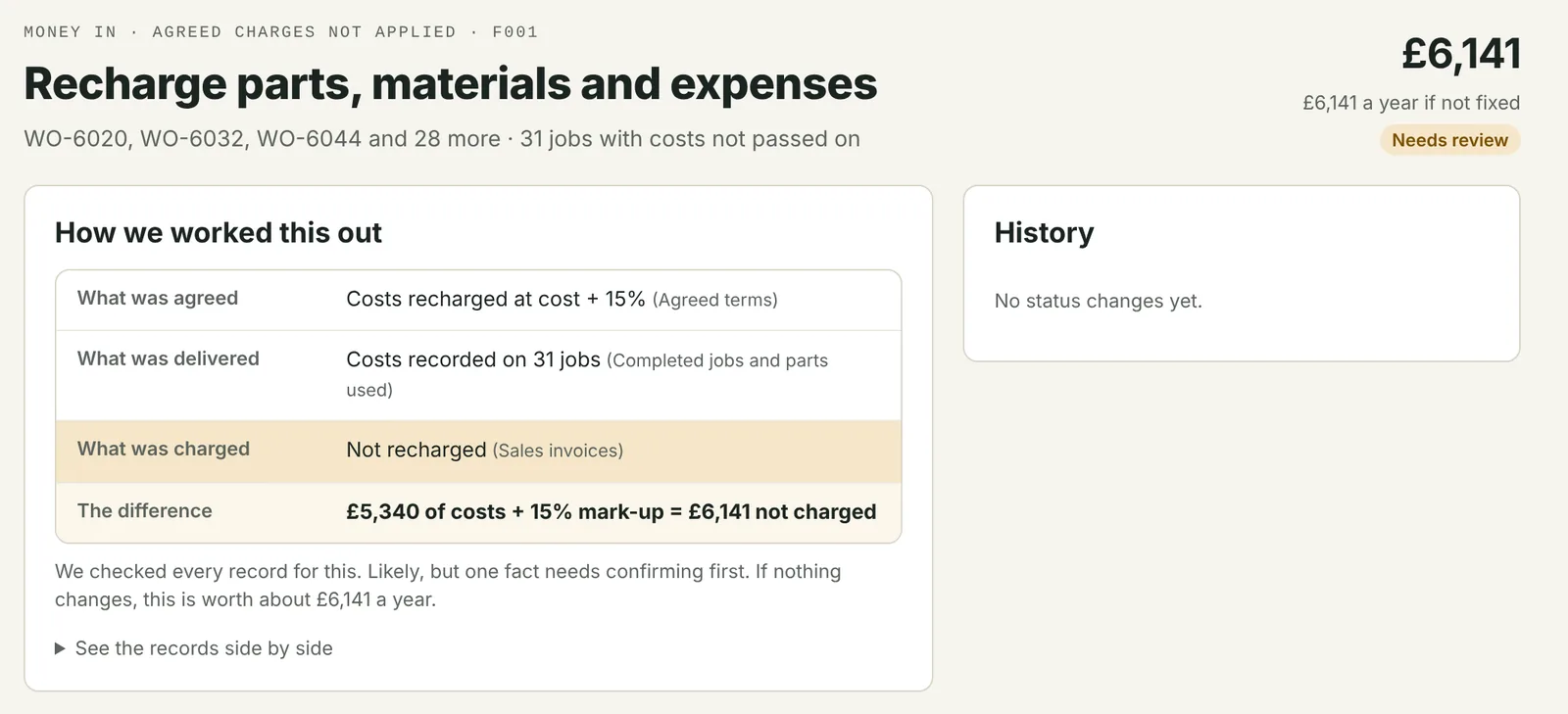
- Agreed charges not appliedUplifts, minimums, yearly price rises, recharged costs and extra users.For example: 16 out-of-hours call-outs charged at the normal rate.
- Charged, not collectedOverdue and written-off invoices, failed payments, takings not banked.For example: two invoices more than 60 days past their terms.
- Given awayDiscounts beyond the limit, credit notes, voids and complimentary items.For example: discounts of 12% where the limit is 5%.
- Sold below costWork that costs more to deliver than it earns.For example: a job that used more hours than its price could cover.
Pay only what you agreed.
Suppliers make mistakes too, and they rarely make them in your favour.
- Paid more than agreedSupplier prices creeping above the agreed rate.For example: plasterboard invoiced at £9.10 against an agreed £8.40.
- Not received, or paid twiceShort deliveries charged in full, and duplicate invoices.For example: the same supplier invoice paid twice within three days.
- Rebates and credits not claimedVolume rebates and credits you are owed.For example: a 2.5% rebate due once yearly spend passed £150,000.
- Paying for unused thingsLicences, seats and subscriptions nobody uses.For example: 210 software licences paid for, 174 in use.
Make the day work better.
Time isn’t cash, so we never count it as cash. But it is often where the biggest improvements are.
- Effort over planJobs that used far more time than estimated.For example: three projects 30% over their estimated hours.
- Rework and repeat visitsReturn trips and redone work, with the reasons.For example: 24 return visits in a year.
- Waiting and delayHow long it takes to invoice, and to get paid.For example: work finished a median of 14 days before it was invoiced.
- Capacity and adminNon-chargeable time and hours not accounted for.For example: 19% of recorded time non-chargeable.
Every finding says how it was found.
Checked against every record
Every record matched against the agreed terms. The strongest evidence, and most findings come this way.
A sample checked by hand
Where records can’t be matched line by line, we check a sample and scale it up, clearly marked as an estimate.
From talking to your team
Things the records don’t show, from interviews and watching the process. Shown as our estimate.
Each finding also shows how confident we are, the value found in the period checked and, where the cause is still running, what it is worth a year if nothing changes. Anything that looks like possible fraud is raised privately with the owner. A review is not an audit and does not give tax or legal advice.
See what’s already in your records.
A free 30-minute intro call. We’ll tell you honestly whether a review is likely to be worth it.